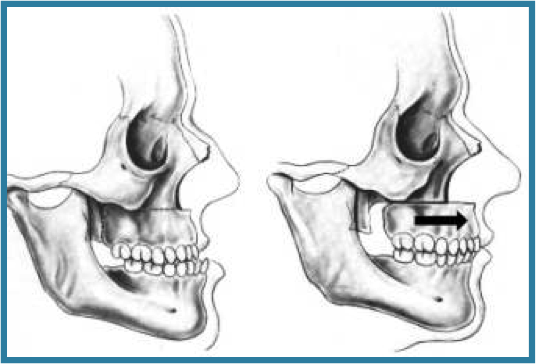
SURGICAL REHABILITATION OR ORTHOGNATHIC SURGERY
Orthognathic surgery is indicated when the upper and lower jaws are not aligned harmoniously. When, for example, there is space between the teeth, even after they are aligned by the orthodontist, or when the teeth have insufficient space to align in the jaws. The teeth must be realigned by orthodontic treatment and then orthognathic surgery is performed to align the jaws. This not only restores facial harmony for the person but also restores the masticatory function by ensuring that the teeth mesh perfectly.
What are the Indications?
Patients who usually require orthognathic surgery are those who have chewing problems, or whose jaws are not aligned properly (chin too far forward or too far back). The poor positioning of the jawbones can lead to various problems, such as slurred speech, chewing problems and health problems in general. Trauma or certain congenital malformations may also be indications for orthognathic surgery.
If you have difficulties in these areas consider talking to your surgeon:
- Difficulty chewing, biting or swallowing
- Speech problems
- Temporomandibular jaw or joint pain
- Persistent space between the front teeth when the jaw is closed
- Chin too far back or forward
- Breathing problems
Orthognathic surgery is an intervention that is planned a long time in advance, and that is done in a multidisciplinary way between different doctors: dentists, orthodontists, and maxillofacial surgeons.
Surgical Technique
Dr. Nathalie Portier-Marret trained in post-graduate orthognathic surgery for 6 months in a large center of European orthognathic surgery (Center Hospitalier de Lyon Sud).
A thorough radiological study and clinical examination must be done in a systematic way to precisely determine the type of treatment to be considered. Before surgery, plaster models will be made to simulate the future position of your jaws.
This important surgery is prepared and analyzed many months in advance in a multidisciplinary way between the dentist, the orthodontist and the Maxillofacial surgeon.
The surgical techniques used will be explained at length and shown in diagram and video form according to each particular case.
Once the osteotomies have been performed (the cutting of the jaws according to very precise marks), the jaws will be repositioned with surgical guides (made-to-measure) and bolted (titanium) osteosynthesis plates, which will allow the rapid bone healing. These plates are the same that are used for traumatic fractures of the face.