About the intervention
The maxillary sinuses are cavities in the bones of the face (in the cheeks), located above the upper teeth. The roots of some teeth (such as premolars or molars) may be partly contained in the sinuses. When these teeth are extracted or lost, there is usually only a thin wall separating the mouth from the sinuses. To replace these teeth with implants, a sufficient thickness of bone is needed to ensure the stability of these teeth. If the sinus wall is very thin, then it is impossible to place implants satisfactorily.
This problem can be solved by performing a minor surgical procedure called a sinus lift.

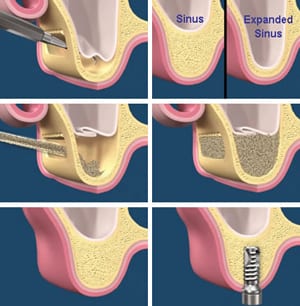
The procedure takes place in the office under local anesthesia. The maxillofacial surgeon opens the wall of the maxillary sinus from the side and delicately raises the membrane that lines the sinus so that the surgeon can add bone (often a mixture of artificial bone and bone from the patient himself) see video below. After 4 to 6 months of healing, the graft material is replaced by the patient’s natural bone and an implant can then be placed and integrated into the ossified sinus.
Today, sinus grafts allow many patients to benefit from dental restorations by implants, whereas in the past they would have had no choice but to use a removable prosthesis.